
CARE
WASH SMART
By caring for your clothes through proper care, washing and drying, you can preserve their quality and extend their lifespan. An added benefit is a positive contribution to environmental protection.
Did you know that the best way to reduce your environmental impact is to take care of your clothes and use them for as long as possible? If you buy high-quality clothes, they will serve you longer – especially if you wash them the right way.
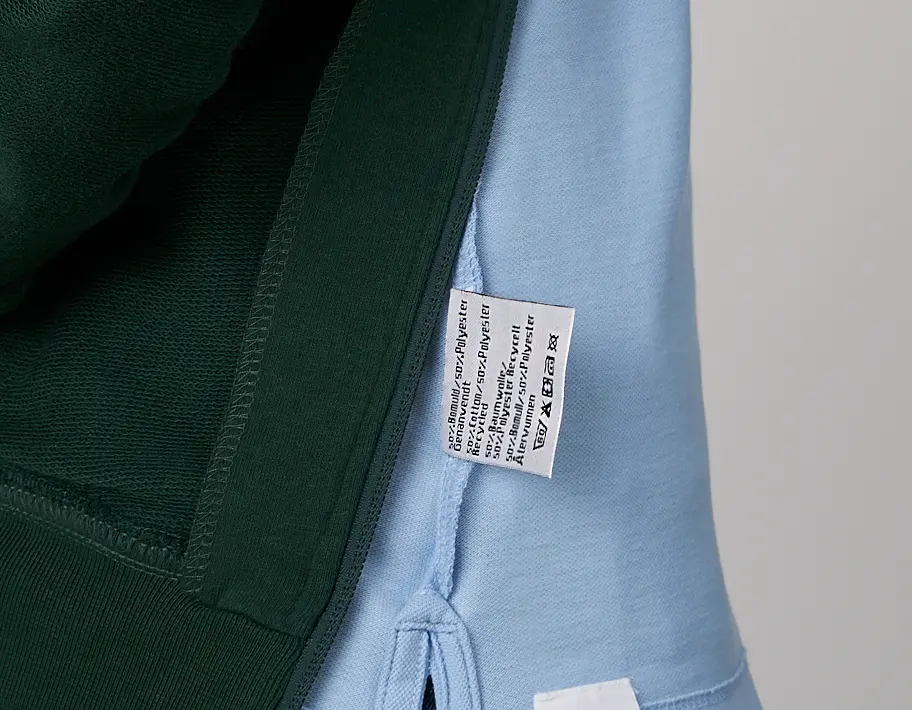
ALWAYS check the care label
Before washing garments, always check the information on the label, which is usually located on the inside of the garment.
The care label is your best friend when clothes need cleaning. It contains instructions on how best to care for, wash and dry them so that they retain their quality and durability.
CARE SYMBOLS
What do the washing symbols mean?
Below you will find an overview of the washing symbols given on the care labels of ID® Identity clothing.
Washing
The symbol indicates whether home washing is possible and gives the temperature.
Hand wash (at 40 °C)
Dissolve the detergent in water, place the garment in and leave it to soak. Do not knead, stretch or wring the material. Then rinse the garment and squeeze out the excess water.
Very gentle machine wash 30 °C
Very gentle cycle, below 1000 rpm. Remember to load the machine lightly and spin.
Gentle machine wash 30 °C
Gentle cycle, 800–1000 rpm.
Machine wash 30 °C
Normal cycle, above 1000 rpm.
Very gentle machine wash 40 °C
Very gentle cycle, below 1000 rpm. Remember to load the machine lightly and spin.
Gentle machine wash 40 °C
Gentle cycle, 800–1000 rpm.
Machine wash 40 °C
Normal cycle, above 1000 rpm.
Machine wash 60 °C
Normal cycle, above 1000 rpm.
Machine wash 80 °C
Normal cycle, above 1000 rpm.
Do not wash
The product must not be washed, as it may be sensitive to water.
Bleaching
The triangle indicates whether the garment tolerates bleaching.
Do not bleach
Indicates that bleaching is not allowed. Use only detergents without bleach.
Drying
The square indicates that the garment can be tumble dried and gives the drying temperature.
Tumble dry low
Product suitable for tumble drying at low temperature (60 °C).
Tumble dry high
Product suitable for tumble drying at high temperature (80 °C).
Do not tumble dry
The product must not be tumble dried.
Line dry
Gently stretch the product to restore its shape after washing and dry it hanging. When drying coloured clothing outdoors, choose a shaded spot to protect the colours.
Dry flat
Gently stretch the product to restore its shape after washing and dry it flat. When drying coloured clothing outdoors, choose a shaded spot to protect the colours.
Ironing
The icon indicates whether the garment can be ironed and gives the ironing temperature.
Iron at low temperature
Iron at low temperature – max. 100 °C.
Iron at medium temperature
Iron at medium temperature – max. 150 °C.
Iron at high temperature
The iron temperature must not exceed 200 °C.
Do not iron
Do not steam or iron the garment.
Professional cleaning
The circle indicates whether the garment is suitable for industrial washing and drying.
Professional gentle cleaning agent
A gentle cleaning agent based on perchloroethylene, mineral turpentine or a similar agent.
Professional cleaning
The garment can be cleaned in perchloroethylene.
Do not clean
The garment must not be cleaned. Do not use stain removers containing solvents.
QUALITY IS PART OF EVERYDAY LIFE
All our products undergo a rigorous quality assurance process
All our products undergo a rigorous quality assurance process at a level consistent with the guidelines set out in our Quality Manual.
We want to deliver high-quality garments that will serve their users as long as possible and that can be put on and worn again and again. With this in mind, for more than three decades we have been testing our products in the Quality Lab. They are also tested by Corporate Wear users around the world.
Pay attention to, among other things:
The difference in shrinkage, e.g. up to ±5–7% for moisture-wicking clothing and ±5% for other products; as well as dimensional tolerances of up to ±1.5 cm.